February 5, 2026 · 3 min read
The Home Office Air Problem Nobody Talks About
We've perfected the ergonomic setup for remote work, but we've ignored the most critical element of the home office: the air we breathe.
In Summary
- Most home offices are small rooms with closed doors and no dedicated ventilation monitoring.
- CO2 can accumulate quietly throughout the workday, acting as a hidden drain on productivity.
- Awareness of your home air quality can be the simplest intervention for better focus.
If you've ever searched:
"Home office air quality"
"Work from home productivity tips"
"WFH tired all the time"
You are experiencing the hidden cost of the remote work revolution.
Over the last few years, millions of us have built the perfect home office. We bought ergonomic chairs. We elevated our monitors. We perfected our lighting.
We engineered everything for productivity.
Except the air.
The Box We Work In
Think about the architecture of a typical home office.
It is often a spare bedroom. It is small.
To block out the noise of pets, partners, or street traffic, we close the door.
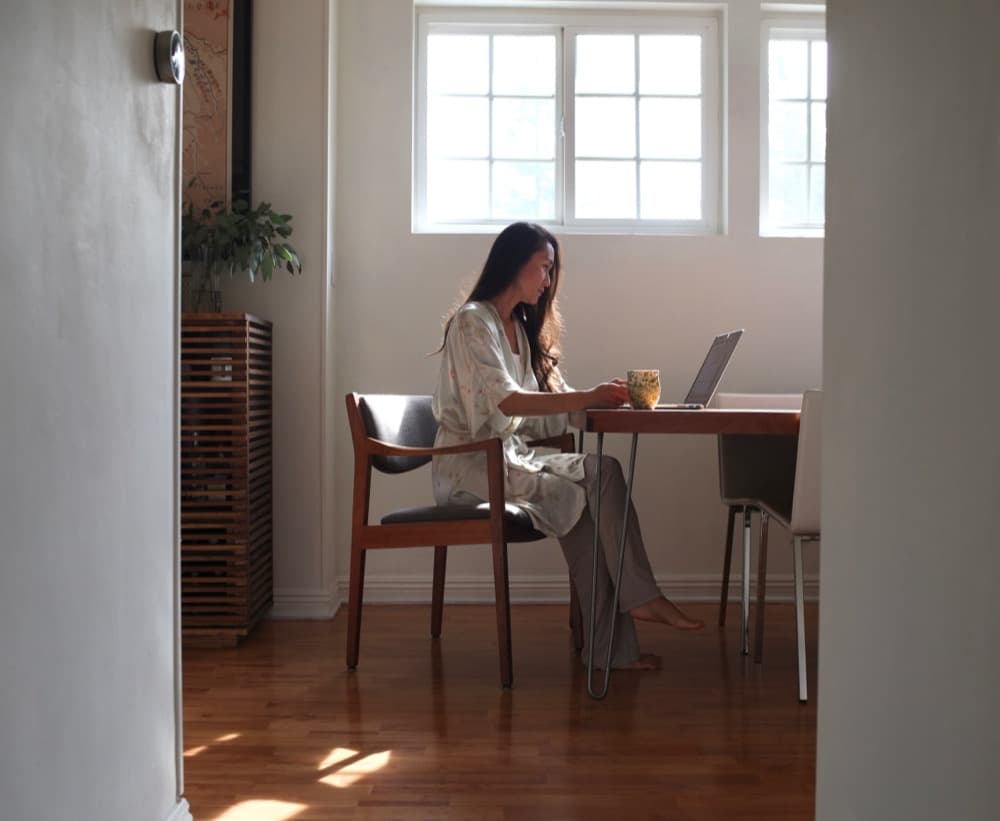
In doing so, we trap ourselves in a sealed box for eight hours a day.
Corporate offices, for all their faults, usually have industrial HVAC systems designed to cycle fresh air.
Your spare bedroom does not.
The Invisible Drain on Focus
When you sit at your desk and breathe, carbon dioxide (CO2) accumulates.
Because the room is small and sealed, the concentration rises quickly.
In a typical home office, CO2 can climb from an optimal 400–800 ppm to over 1,500 ppm in just a couple of hours.
You won't notice it at first. The air won't smell bad.
But as the numbers creep up, your cognitive performance may subtly decline.
Research suggests that high CO2 levels in enclosed spaces can impair decision-making, slow down information processing, and increase perceived fatigue.
When you hit a wall at 2pm and stare blankly at your screen, you likely blame your work ethic.
You might just need oxygen.
The Illusion of the "Afternoon Slump"
We are incredibly quick to medicalise our lack of focus.
We think we need more coffee. We think we need a new productivity app. We think we need to biohack our circadian rhythms.
But if you are sitting in a room with 1,800 ppm of CO2, your brain is simply operating at a disadvantage.
It is starved of the environmental conditions it needs to perform.
The Simplest Productivity Hack
You cannot fix a problem you cannot see.
A continuous air quality monitor in your home office makes the invisible visible.
When you can see the CO2 climbing in real-time, the solution is embarrassingly simple.
You don't need another cup of coffee.
You just need to open the window for five minutes. You need to leave the door ajar.
It is the highest-leverage productivity intervention available to remote workers.
Because deep work doesn't just happen in your brain.
It happens in a room.